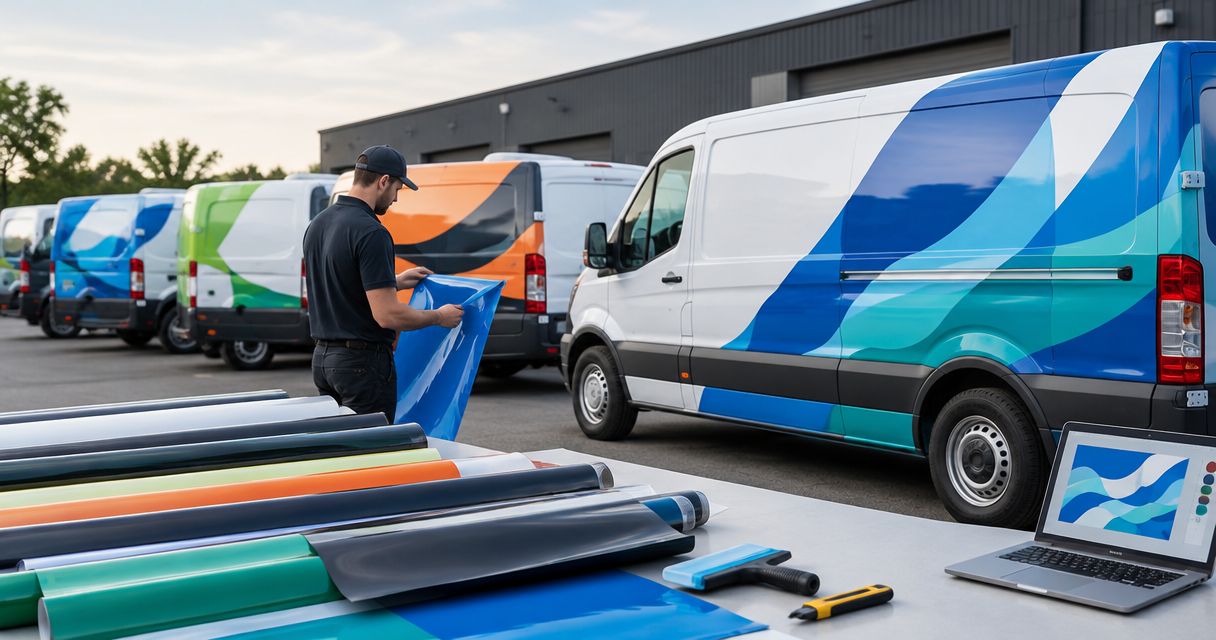
Best overall: cast wrap vinyl. Best for flat-panel graphics: polymeric calendered vinyl. Best for simple fleet identification: cut cast-vinyl lettering. This 2026 guide compares the best vehicle wrap materials for fleets by panel shape, message, installation demands, and replacement needs.
- The best vehicle wrap materials for fleets start with cast vinyl for curved body panels.
- Choose polymeric calendered vinyl for flat graphics only when its application specifications match the vehicle.
- Cut cast-vinyl lettering suits fleet identification without full-body coverage.
- Image Monster is best for Wilmington businesses that want hands-on design and production for fleet graphics.
Why this matters for Wilmington fleets
A fleet wrap has to fit the vehicle, not just the artwork. Flat box-truck sides, recessed van panels, door lettering, and rear windows need different material decisions. Choosing by appearance alone leaves the installation requirements unanswered.
For Wilmington and southeast North Carolina businesses, Image Monster brings over 25 years in business, in-house design and production, and personal service to vehicle graphics planning. Bring vehicle photos and your business message before choosing a film. A material name cannot replace a review of the actual surface.
For a 2026 fleet project, start with the job each vehicle performs. A service van needs readable identification; a delivery vehicle might also need product imagery. Those goals do not automatically require the same coverage.
What makes the best vehicle wrap materials for fleets?
Judge fleet graphics against these criteria before comparing samples:
- Panel fit: Match the film to flat surfaces, gentle curves, compound curves, and recesses. Check the specific film's application guidance.
- Dimensional stability: Look at how the film handles stretching and its tendency to shrink after installation. Construction matters here.
- Message clarity: Choose full printed coverage, lettering, or targeted graphics according to what drivers and customers need to read.
- System compatibility: Confirm that printable film, ink, and protective laminate belong together. A familiar brand name alone does not establish compatibility.
- Serviceability: Plan how damaged panels, changed phone numbers, and replacement vehicles will receive matching graphics.
- Removal requirements: Discuss paint condition and eventual removal before installation. No material choice makes questionable paint a safe surface.
For your 2026 specification, record the exact film and laminate names on the approved job details. “Premium vinyl” is a description, not a material specification.
Fleet wrap materials at a glance
The ranking below separates full-wrap films from specialized graphics. Lettering, reflective graphics, and perforated window film are different applications, not interchangeable substitutes for a body wrap.
| Rank and option | Best for | Standout feature | Key limitation |
|---|---|---|---|
| Cast wrap vinyl | Full wraps on curved vehicle bodies | Conformability and dimensional stability | Requires suitable surfaces and skilled installation |
| Polymeric calendered vinyl | Flat-panel fleet graphics | Fits applications that do not demand deep conformability | Not a default choice for recesses or compound curves |
| Cut cast-vinyl lettering | Simple business identification | Individual letters without a printed background panel | Cannot reproduce photographic artwork |
| Reflective vehicle graphics | Targeted nighttime identification | Returns incident light toward its source | Application limits vary by film |
| Perforated window film | Supplemental rear-window messaging | Printed graphics with perforations through the film | Changes outward visibility and needs a legal review |
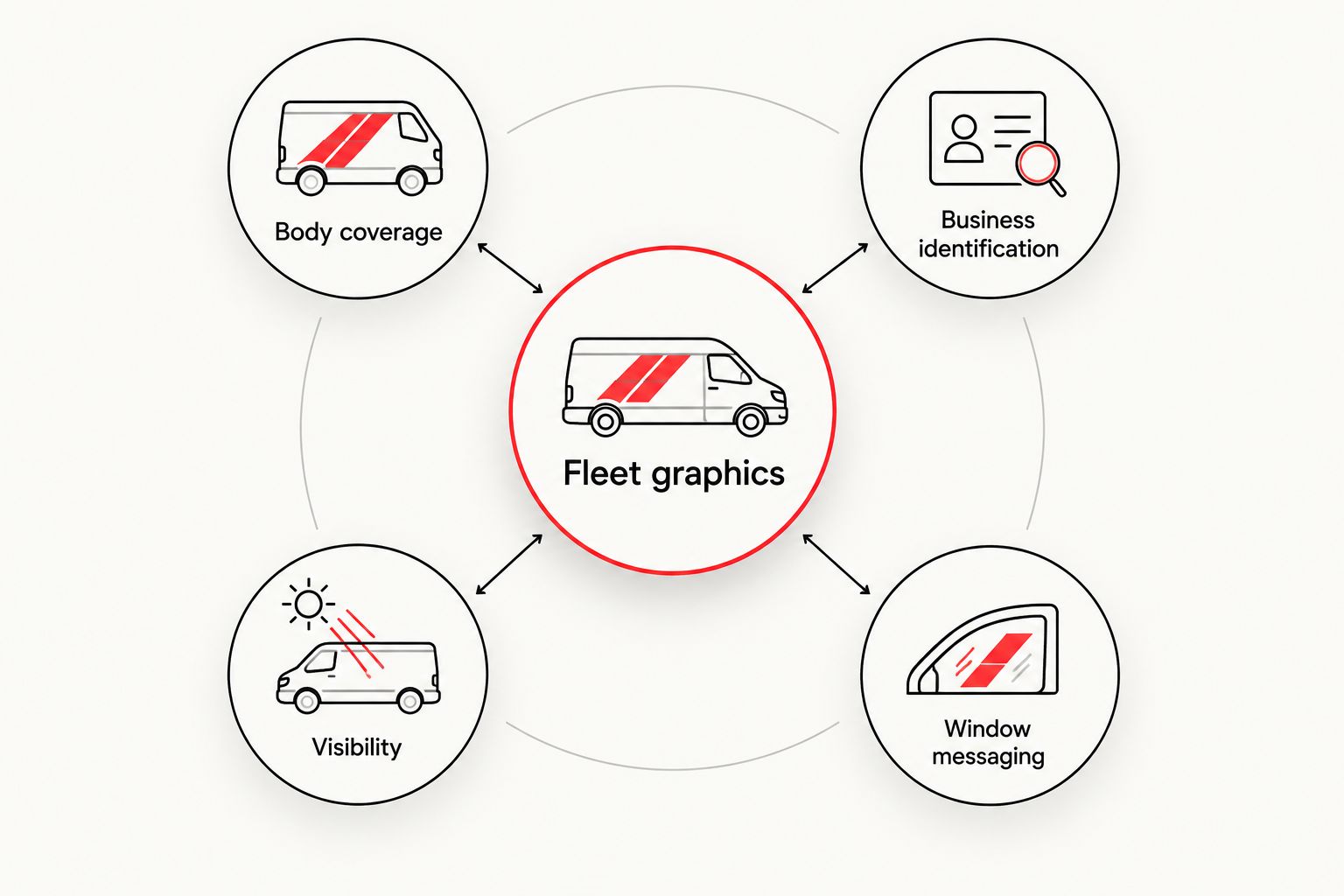
Think in layers of purpose: body coverage, business identification, visibility, and window messaging. A fleet can combine these approaches without covering every surface.
1. Cast wrap vinyl: best for curved commercial vehicles
Cast wrap vinyl is the default recommendation for full graphics on vehicle bodies with curves and contours. Its manufacturing process produces a film suited to conformable applications, with better dimensional stability than calendered alternatives.
Cast wrap vinyl is the best overall choice for fleet wraps that must follow curved body panels. Still, the exact product matters: a film's technical guidance determines which recesses, surfaces, and installation methods it supports.
Cast wrap vinyl pros:
- Conforms to vehicle shapes that challenge flatter-use films.
- Supports printed fleet artwork across large body areas.
- Offers dimensional stability suited to demanding wrap applications.
- Works as part of a specified print-and-laminate system.
Cast wrap vinyl cons:
- Does not compensate for peeling paint, corrosion, or poor preparation.
- Needs careful installation around contours, edges, and recesses.
- Requires product-specific guidance rather than assumptions about all cast films.
Best for: Service vans, pickups, and other commercial vehicles with curved panels and extensive graphics.
Ask the installer which areas require seams or a different installation approach. Approve those decisions with the layout, not after the vehicle is wrapped.
Verdict: Buy cast wrap vinyl for full-body fleet graphics on curved vehicles.
2. Polymeric calendered vinyl: best for flat-panel fleet graphics
Polymeric calendered vinyl belongs in the conversation when the graphic sits on a flat surface and does not need deep stretching. Think box-body panels and simple flat graphic areas—not an automatic substitute for cast film across an entire van.
Calendered film is manufactured differently from cast film and generally has greater shrinkage tendencies. “Polymeric” alone does not establish suitability for a vehicle application; the specific film still needs approval for the intended surface.
Polymeric calendered vinyl pros:
- Suits flat graphics when the product specifications support the application.
- Carries printed business messages and large artwork.
- Gives flat-panel projects a distinct alternative to complex body wrapping.
Polymeric calendered vinyl cons:
- Is not the default choice for compound curves or deep recesses.
- Has greater dimensional movement concerns than cast wrap film.
- Needs careful product selection; calendered films are not all equivalent.
Best for: Flat-sided commercial bodies and flat graphic panels with straightforward installation requirements.
Check the vehicle itself. Rivets, corrugations, seams, and damaged surfaces make an apparently flat application more demanding.
Verdict: Buy for approved flat-panel applications; skip as a blanket replacement for cast wrap vinyl.
3. Cut cast-vinyl lettering: best for simple fleet identification
Cut cast-vinyl lettering puts individual letters and shapes directly on a vehicle without a printed background panel. It suits business names, service descriptions, and contact details when the message matters more than full-body imagery.
This option describes both a material and a production method. Specify cast lettering film where the surface requires its conformability, and keep the design appropriate for cut graphics.
Cut cast-vinyl lettering pros:
- Keeps business identification visually focused.
- Leaves the vehicle's paint visible around letters and shapes.
- Supports a consistent name-and-contact layout across a fleet.
- Allows separate graphic elements instead of a continuous printed background.
Cut cast-vinyl lettering cons:
- Does not reproduce photographs or continuous-tone printed imagery.
- Small lettering and intricate shapes complicate production and installation.
- Changes and removals still require attention to the underlying finish.
Best for: Contractors and service businesses that need clear identification without full-body coverage.
Start with the business name and core service. Add contact information only after checking that the layout remains readable; filling every empty door panel is not a design goal.
Verdict: Buy cut cast-vinyl lettering when clear fleet identification is the main job.
4. Reflective vehicle graphics: best for nighttime identification
Reflective graphics return incident light toward its source. That makes them useful for selected business names or identification details when headlights illuminate a vehicle.
Reflective film is not simply standard wrap vinyl with a different finish. Product constructions and installation limits vary, so ask for a film approved for the intended vehicle surface.
Reflective vehicle graphics pros:
- Add a distinct function to targeted identification graphics.
- Can complement a conventional printed wrap or lettering layout.
- Let selected information receive emphasis under incident light.
Reflective vehicle graphics cons:
- Do not produce their own light.
- Have product-specific limits on stretching and conformability.
- Do not replace legally required lighting or vehicle markings.
Best for: Fleet identification intended to remain noticeable when illuminated after dark.
Separate branding decisions from regulated safety markings. A business logo and required conspicuity treatment serve different purposes, even when both use reflective materials.
Verdict: Buy reflective graphics for a defined identification need, not as a universal full-wrap material.
5. Perforated window film: best for supplemental window messaging
Perforated window film carries printed graphics across a film containing small openings. It adds messaging to approved window areas while allowing a view through those openings.
That view is not equivalent to clear glass. Lighting conditions, the graphic, and the application affect the viewing experience, so review the driver's sightlines before approving the design.
Perforated window film pros:
- Adds a separate messaging area beyond painted body panels.
- Supports printed graphics rather than only individual letters.
- Can coordinate window artwork with the body design.
Perforated window film cons:
- Changes visibility through the covered glass.
- Requires checks against applicable window and vehicle rules.
- Needs application planning around wipers, window edges, and obstructions.
Best for: Supplemental rear-window graphics where the vehicle configuration and applicable rules permit them.
Keep essential business identification on the body rather than depending entirely on a window graphic. The window treatment should support the message, not carry the whole job.
Verdict: Hold until visibility, legal requirements, and the exact application are confirmed.
How the materials rank
This 2026 ranking puts panel fit first, followed by message clarity, system compatibility, and serviceability. Cast wrap vinyl leads for curved full-body applications; the other options win narrower jobs rather than competing for the same installation.
No single material earns every position. A flat box body and a contoured service van have different demands, even when they share the same business identity.
Build a fleet quote that answers the right questions
A useful quote starts with the vehicles and the message—not a request for “the best vinyl.” Send current photos of each vehicle's sides, rear, and existing graphics, along with vehicle details and the artwork you already use.
For Image Monster fleet graphics projects, use this practical brief:
- Vehicle condition: Identify repairs, repainted areas, damage, and existing graphics.
- Coverage: Specify full wrap, partial coverage, lettering, or a combination.
- Material system: Request the proposed film and any matching protective laminate.
- Business message: Confirm the exact name, service wording, and contact details.
- Replacement plan: Discuss how future vehicles and repaired panels will match.
Approve the design on the vehicle layout, not just as a standalone logo. Door gaps, handles, wheel arches, and body breaks can interrupt a message that looks clear on a blank page.
Image Monster handles design and production in-house, giving Wilmington business owners a direct place to discuss those details. Local craftsmanship still starts with a suitable surface and a clear specification. Ask for both before approving production.
Which fleet wrap material should you choose?
Choose cast wrap vinyl as the default for a curved commercial-vehicle wrap. Choose cut lettering when identification is the real goal, and reserve polymeric calendered vinyl for flat applications supported by the film's specifications.
For your 2026 fleet plan, treat reflective and perforated films as targeted additions. Neither should replace the body material decision. Write the application first, then select the film that fits it.
FAQ
What's the best vehicle wrap material for a commercial fleet?
Cast wrap vinyl is the best overall choice for commercial fleets with curved body panels and extensive graphics. Select the exact film and compatible laminate according to the vehicle surface and manufacturer's application guidance.
Is cast vinyl better than calendered vinyl for work vans?
Cast vinyl is the better default for work vans with curves and recesses. Polymeric calendered vinyl belongs on suitable flat applications when the specific product supports vehicle use.
Do I need a full wrap to identify my business vehicles?
No, cut vinyl lettering can provide business identification without full-body coverage. Use it for a focused business name, service description, and contact information when photographic graphics are unnecessary.
Can reflective vinyl replace a regular fleet wrap?
Reflective vinyl should be selected for its specific identification function, not assumed to replace ordinary wrap film. Confirm the product's surface and installation limits, and keep required safety markings separate from branding decisions.
Can I put perforated graphics on a commercial vehicle window?
Use perforated window graphics only after checking the vehicle configuration, driver visibility, and applicable rules. Perforations allow a view through the film, but the covered glass does not perform like clear glass.
How much does a fleet wrap cost?
Get a vehicle-specific quote based on coverage, artwork, surface condition, materials, and installation requirements. Compare proposals with the same scope rather than treating lettering and full wraps as equivalent jobs.
Where can I discuss fleet wraps in Wilmington, NC?
Visit Image Monster at 4724 New Centre Dr in Wilmington or call (910) 313-1154. Bring vehicle photos and your business artwork to discuss lettering, wrap coverage, and a project quote.
One last thing: design for the next vehicle, too
A consistent fleet does not require identical coverage on every body shape. It requires a clear rule for where the name, service, and contact details belong. Set that rule before the first installation so the next vehicle starts with an approved direction.
Ready to plan your 2026 fleet graphics? Call (910) 313-1154 or visit Image Monster at 4724 New Centre Dr, Wilmington, NC. Bring your vehicle photos, discuss the material choices, and request a quote built around the work your fleet actually does.