Best overall: scrim-reinforced solid PVC. Best for exposed fences: mesh PVC. Best for double-sided messages: blockout PVC. The best vinyl banner material for outdoor use in 2026 depends on where you install it, how wind reaches it, and whether people need to read one side or both.
- Scrim-reinforced PVC is the best vinyl banner material for outdoor use against a supported wall.
- Choose mesh PVC for exposed fences; its openings let air pass through.
- Choose blockout PVC when opposite-side graphics must remain separate and readable.
- Image Monster provides Wilmington businesses with custom signs and in-house design and production.
Why this matters
An outdoor banner needs more than a printable surface. Its material, edge finishing, attachment points, and mounting location must work together. A heavier sheet does not fix a weak fence or poor attachment layout.
For Wilmington and southeast North Carolina businesses, start with the installation site—not the material name. Image Monster brings over 25 years of sign-making experience to custom business signage, with hands-on design and production.
Image Monster suits Wilmington businesses that want custom outdoor signage with in-house design and production. Bring a photo of the location, the intended message, and your mounting measurements before choosing the banner specification.
What makes the best outdoor banner material?
Use these criteria to compare outdoor banner materials in 2026. They matter more than a material being described simply as heavy-duty.
- Wind exposure: Solid material catches air; mesh allows some air through. Neither removes the need for secure mounting.
- Viewing conditions: Match the surface to your lettering, viewing distance, and background. Small details need a different treatment from a large roadside headline.
- Light control: A blockout layer helps keep reverse-side graphics from showing through. This matters when printing both faces.
- Construction: Look at the reinforcing fabric and finished edges, not just the listed weight. The complete banner carries the load.
- Attachment method: Specify ties, grommets, pole pockets, or another mounting approach before production. Do not treat finishing as an afterthought.
- Installation suitability: Check the fence, wall, frame, or posts. A banner cannot compensate for an unsuitable support.
Outdoor banner materials at a glance
These are material categories, not a list of confirmed stock at a particular shop. Ask your sign maker to recommend the exact construction for your site.
| Material | Best for | Standout feature | Key limitation |
|---|---|---|---|
| Scrim-reinforced solid PVC | Single-sided banners on supported walls | Continuous print surface with fabric reinforcement | Catches more wind than an open mesh construction |
| Mesh PVC | Exposed fences and open-air installations | Perforated construction lets air pass through | Openings reduce image solidity and fine-detail clarity |
| Blockout PVC | Double-sided banners and strong backlighting | Opaque layer separates the printed faces | Blockout construction alone does not reduce wind load |
Treat these as different solutions, not increasingly better grades. Mesh solves an airflow problem. Blockout solves a light-transmission problem. Solid reinforced PVC supplies a continuous surface for straightforward outdoor messaging.
1. Scrim-reinforced PVC: best for supported wall banners
Scrim-reinforced PVC combines a printable vinyl surface with an internal reinforcing fabric. For a single-sided business banner installed against a suitable wall or support, it is the default starting point.
Its continuous surface gives lettering, photos, and solid colors an uninterrupted background. Choose it for a storefront announcement, service message, or temporary directional banner where the installation does not leave a large sheet exposed to airflow from behind.
Scrim-reinforced PVC pros
- Clear graphic surface: There are no mesh openings breaking up letters or images.
- Fabric reinforcement: The internal scrim supports the banner structure.
- Flexible design: Large lettering, logos, and photo-based layouts can share the same surface.
- Straightforward specification: You can discuss material, edge finishing, and attachments as a complete outdoor banner.
Scrim-reinforced PVC cons
- Wind resistance: A solid sheet catches air, so exposed mounting needs particular care.
- No automatic light blocking: A standard solid banner is not necessarily suitable for opposing graphics or a bright background.
- Weight is incomplete information: A heavier listing does not establish better printing, stronger attachments, or a safer installation.
Best for: A Wilmington business needing a clear, single-sided message on a supported exterior surface.
For a 2026 storefront project, first confirm whether the banner will sit close to a wall or stretch across an open gap. Those are different installations, even when the finished dimensions match.
Verdict: Buy scrim-reinforced solid PVC for a supported, single-sided outdoor banner; skip it as an automatic choice for exposed fences.
2. Mesh PVC: best for exposed fence banners
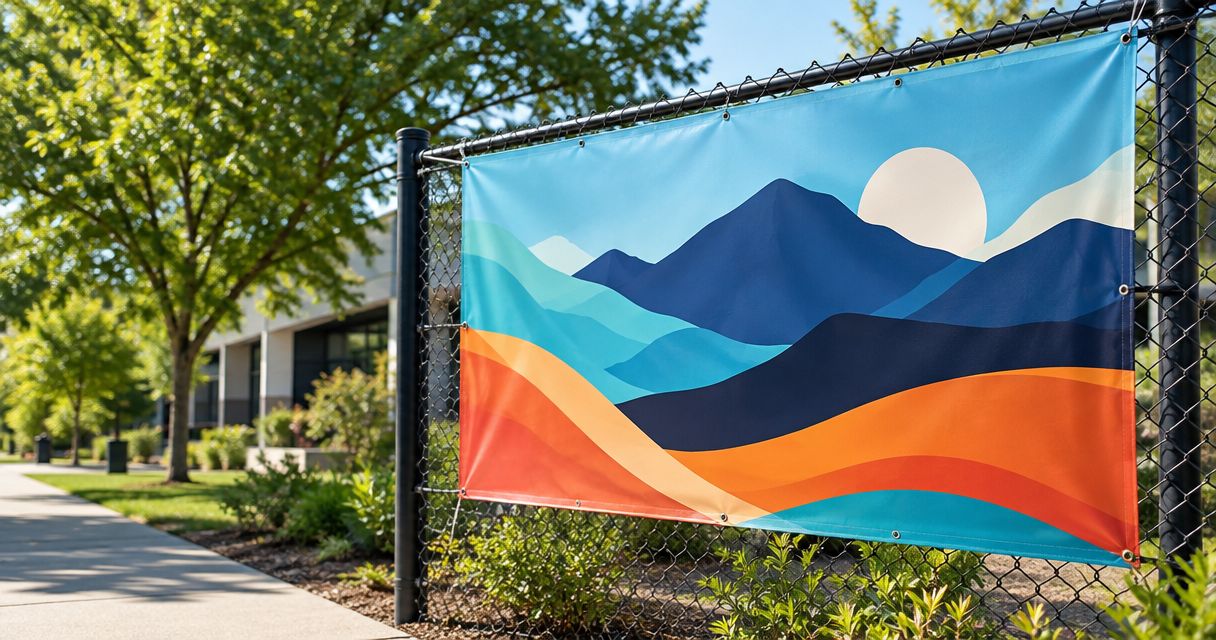
Mesh PVC has openings across the printed surface that let air pass through. That makes it the stronger starting point for a fence banner where a solid sheet would catch more wind.
The trade-off is visual: some of the image area is open space. Use bold lettering and a simple layout rather than expecting small text or detailed photography to read like a continuous solid print.
Mesh PVC pros
- Air passage: The openings reduce the continuous surface presented to the wind.
- Fence suitability: Mesh addresses an important concern in open-air fence installations.
- Large-message focus: A simple business name, service, or directional message fits the format well.
Mesh PVC cons
- Reduced visual density: The background remains visible through the openings.
- Detail limitations: Small lettering and fine image details lose clarity through the mesh pattern.
- Mounting still matters: Mesh does not make a weak fence safe or eliminate wind-related loads.
Best for: Businesses placing a large, simple message on an exposed fence or similar open support.
Ask how the proposed mesh construction affects both airflow and the printed appearance. Then check the design against the actual background: vegetation, parked vehicles, and building surfaces can all show through.
Do not add improvised cuts to a solid banner as a substitute for choosing the right construction. Specify the intended installation before printing, including the support condition and how the banner will attach.
Verdict: Buy mesh PVC for an exposed fence installation when airflow matters more than dense photographic detail.
3. Blockout PVC: best for double-sided outdoor banners
Blockout PVC includes an opaque layer designed to prevent light and graphics from showing through the material. It is the best fit when the message on one face must stay separate from the message on the other.
Choose it for double-sided outdoor signage or a layout where light behind the banner would interfere with readability. Confirm that the selected material supports the planned printing and finishing on both faces.
Blockout PVC pros
- Face separation: The opaque construction helps keep reverse-side graphics from interfering.
- Light control: The blocking layer reduces unwanted transmission through the banner.
- Double-sided planning: Both viewing directions can be considered in one finished sign.
Blockout PVC cons
- No airflow advantage: A solid blockout banner still presents a solid surface to wind.
- More layout coordination: Both faces must work with the mounting method and intended viewing direction.
- Not always necessary: A single-sided banner against an opaque wall does not automatically need a blockout layer.
Best for: Businesses that need two readable faces or need to control show-through from strong light behind the banner.
For a double-sided project in 2026, approve each face separately. A design that reads correctly on one side does not settle the orientation, margins, or attachment clearance on the other.
Verdict: Buy blockout PVC for two-sided readability; skip it when light transmission is not a problem.
How to choose the material for your location
Use the installation to narrow the options before discussing weight. A clear site photo often answers more useful questions than a request for the thickest available vinyl.
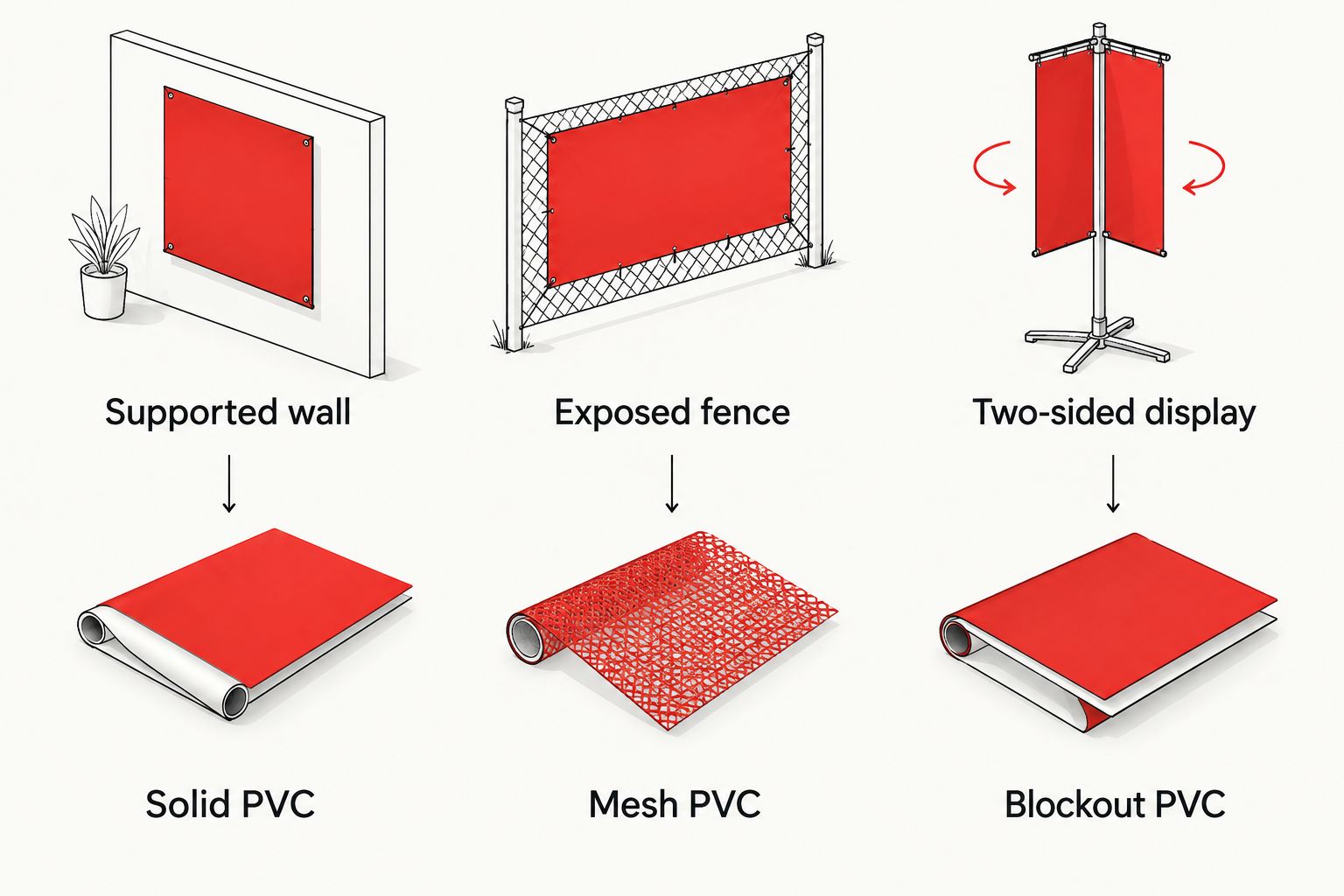
- Supported wall: Start with scrim-reinforced solid PVC for a single-sided message.
- Exposed fence: Start with mesh PVC, then assess the support and attachment plan.
- Two-sided display: Start with blockout PVC, then confirm orientation and finishing.
Before requesting a quote, record the finished width and height, identify the support, and photograph the mounting area. Include whether people will approach from one direction or need to read both sides. Tell the shop whether you plan to leave the banner installed or remove it between uses.
For Image Monster customers, that brief gives the design and production team a concrete starting point. It also keeps the conversation focused on the finished sign rather than a material label alone.
What banner weight actually tells you
Banner weight is commonly expressed in ounces per square yard. A 13 oz/yd² listing describes material mass per area; an 18 oz/yd² listing describes a heavier material per the same area. Neither figure is a wind rating or a service-life guarantee.
Do not read those weights as a good-versus-better ranking. Ask what the material is designed for, whether it includes reinforcement or a blockout layer, and how the finished banner will attach.
For your 2026 order, keep these questions separate:
- Material: Is the construction suitable for the installation?
- Finishing: Are the edges and attachment points specified for the job?
- Support: Can the wall, fence, frame, or posts handle the installation?
A heavy banner on poor attachments is still a poor installation. Choose the complete banner system, not the largest weight number.
How the materials rank
The ranking prioritizes installation fit, readability, light control, and finishing. Scrim-reinforced solid PVC takes the default position because a continuous print surface fits a straightforward single-sided wall banner. Mesh and blockout take their own use-case slots because they address different problems.
This is a category guide for 2026, not a product test or a promise of a fixed outdoor lifespan. Sun exposure, wind, installation, handling, and the complete print specification all affect the finished result.
Which outdoor banner material should you choose?
Choose scrim-reinforced solid PVC for a supported, single-sided wall banner. Choose mesh PVC when the banner will sit on an exposed fence. Choose blockout PVC when opposite-side graphics or light transmission would interfere with readability.
For local business owners, the decision is practical: where will the banner hang, what must people read, and how will it stay attached? Answer those questions before approving artwork or requesting a material substitution.
If the message also needs to travel with your business, discuss vehicle lettering or a vehicle wrap as a separate sign project. A banner serves its installation site; vehicle graphics serve a different application and need their own design brief.
FAQ
What's the best vinyl banner material for outdoor use?
Scrim-reinforced solid PVC is the default choice for a single-sided outdoor banner on a suitable supported wall. Choose mesh PVC for exposed fences and blockout PVC for double-sided messages or unwanted light transmission.
Is mesh better than solid vinyl for a fence banner?
Mesh is the better starting point for an exposed fence banner because its openings let air pass through. The trade-off is reduced image solidity, and the fence and attachments still need assessment.
Is heavier vinyl always better for outdoor banners?
No. Material weight describes mass per area, not the suitability of the complete installation. Reinforcement, edge finishing, attachment points, and support condition also matter.
What material should I use for a double-sided outdoor banner?
Use a blockout banner material specified for the intended double-sided printing and finishing. Its opaque layer helps prevent the graphics on one face from showing through the other.
How long will an outdoor vinyl banner last in Wilmington?
An outdoor banner does not have a single lifespan that applies to every Wilmington installation. Ask for guidance based on the selected material, print specification, exposure, mounting, and handling.
What should I send when requesting an outdoor banner quote?
Send the finished dimensions, a photo of the installation site, and a description of the support and attachment method. Include your artwork, intended message, and whether the banner needs one printed face or two.
Where can I discuss a custom outdoor banner in Wilmington?
Visit Image Monster at 4724 New Centre Dr or call (910) 313-1154. Bring your site photos, dimensions, and business message to discuss the design and production requirements.
One last thing
Approve the mounting margins before approving the artwork. Edge finishing, pockets, and attachment points need space; lettering pushed against the edge can conflict with the way the banner is made or installed.
Make your next step concrete. Call (910) 313-1154 or visit 4724 New Centre Dr to discuss your outdoor banner and request a quote. Bring the location photo first—the right material choice starts there.