Best overall: aluminum composite material for reusable listing panels. Best for quick-change open-house signs: corrugated plastic. Best for framed metal panels: aluminum. The best yard sign material for realtors in 2026 depends on how you mount, move, and reuse the sign—not just how it looks on a screen.
- Aluminum composite material is the best yard sign material for realtors reusing rigid listing panels.
- Corrugated plastic suits temporary open-house signs; aluminum suits framed metal panels.
- Expanded PVC suits sheltered displays better than exposed roadside placements.
- Image Monster helps Wilmington businesses with custom signs, in-house design, and production.
Why this matters for Wilmington real estate agents
A listing sign has a simple job: identify the property and make the agent easy to contact. A bent panel, crowded layout, or mismatched frame gets in the way. Choose the panel and its support together.
For your 2026 sign plan, separate reusable listing signs from directional signs that move between properties. Those jobs do not need the same construction. Image Monster brings over 25 years of sign experience and in-house design and production to Wilmington businesses.
Image Monster is a local choice for Wilmington real estate agents who want custom signs with hands-on design and production. Bring your existing frame, artwork, and installation details into the conversation before choosing a substrate.
What makes the best yard sign material for realtors?
Judge the complete sign, not a material sample alone. These criteria determine whether a panel fits your daily work:
- Reuse: Choose a rigid panel for repeated listing assignments; keep temporary directions separate.
- Mounting fit: Match panel thickness, holes, slots, and edges to the actual frame or post system.
- Handling: Consider how you load, stack, carry, and retrieve signs between properties.
- Exposure: Account for sun, rain, wind, and whether the sign sits in an open or sheltered location.
- Readability: Give the business name, contact information, and directional message enough space to work.
- Finish requirements: Confirm the printing method, edge treatment, and any protective finish before production.
A thicker panel does not fix weak mounting. A weather-resistant substrate does not guarantee that every ink, graphic, fastener, and support in the finished assembly has the same suitability.
Yard sign materials at a glance
These are material recommendations, not a statement that every construction is offered for every project. Confirm the finished specification when requesting a quote.
| Material | Best for | Standout feature | Key limitation |
|---|---|---|---|
| Aluminum composite material | Reusable listing panels | Rigid panel with aluminum faces and a composite core | Requires compatible mounting and careful edge handling |
| Corrugated plastic | Temporary open-house directions | Lightweight fluted sheet | Easier to crease or bend during handling |
| Aluminum | Framed metal listing panels | Solid metal sheet without a composite core | Thin panels can dent or flex |
| Expanded PVC | Sheltered display panels | Smooth, rigid plastic surface | Heat and unsupported exposure need careful specification |
1. Aluminum composite: best for reusable listing panels
Aluminum composite material, often called ACM, combines aluminum faces with a composite core. It makes a rigid sign panel without relying on a solid sheet of metal throughout. That construction suits agents who want a consistent panel format across multiple listings.
Best for: reusable property signs mounted in a compatible frame or post system. Ask the fabricator to specify the panel, graphic application, mounting holes, and edge finish as one job. Do not assume a panel will fit simply because its face dimensions match.
Aluminum composite pros
- Rigid construction helps the panel maintain a flat presentation.
- Smooth faces support clear, cleanly arranged graphics.
- Works as a reusable panel when the mounting system allows removal and replacement.
Aluminum composite cons
- Damaged edges and corners need attention during handling and storage.
- An incompatible frame or hole pattern creates installation problems regardless of panel quality.
For a 2026 listing-sign refresh, establish the frame specification before approving the artwork. Keep changing information, such as listing status, on a separate component when your system supports it. That leaves the main branding panel usable across assignments.
Verdict: Buy for a reusable listing-sign system after confirming mounting compatibility.
2. Corrugated plastic: best for temporary open-house directions
Corrugated plastic is a lightweight sheet with internal flutes. It suits signs you carry, position for an event, and collect afterward. For real estate agents, its clearest role is temporary directional messaging rather than replacing every long-term listing panel.
Best for: open-house arrows, event directions, and short-term property messaging. If you plan to use wire stakes, confirm that the sheet's flute direction and stake design work together. The artwork orientation alone does not establish that fit.
Corrugated plastic pros
- Lightweight panels are convenient to carry between locations.
- Fluted construction works with compatible stake systems.
- Separate directional panels let you keep the message focused on the route.
Corrugated plastic cons
- Creases and crushed edges can spoil the panel's appearance.
- Thin, unsupported panels flex, so placement and support matter.
Plan a repeatable collection routine. Remove the signs after the event, wipe away dirt using the printer's care instructions, and store them without heavy objects pressing into the flutes. Reuse starts with handling, not a promise printed on a specification sheet.
Before placing directions away from the listing itself, check current sign rules and obtain permission from the property owner. A temporary message still needs an approved location.
Verdict: Buy for temporary directions; skip as an automatic substitute for a rigid reusable panel.
3. Aluminum: best for framed metal listing panels
Aluminum provides a solid metal face for printed or applied graphics. It is a practical option when your existing sign system is designed around a metal insert. Specify the actual panel thickness and mounting arrangement instead of ordering by material name alone.
Best for: agents replacing panels in a compatible metal-sign frame. Check the frame's channels, clips, and clearance before ordering. Existing hardware should guide the replacement specification—not the other way around.
Aluminum pros
- Solid metal construction avoids a composite core.
- Smooth faces support straightforward branding and contact layouts.
- Can be fabricated with mounting holes suited to the installation.
Aluminum cons
- Thin sheet can bend or dent when loaded or handled roughly.
- Unsupported edges and unsuitable fasteners create avoidable problems.
For your 2026 replacements, bring the old insert or clear measurements to the sign consultation. Include a photo of how the frame holds the panel. A face-on picture of the artwork does not show the details that determine fit.
Aluminum and aluminum composite are different constructions. Neither name alone tells you the finished sign's stiffness, edge quality, or mounting suitability.
Verdict: Buy when a solid metal panel matches your existing frame and handling needs.
4. Expanded PVC: best for sheltered property displays
Expanded PVC is a rigid plastic sheet with a smooth surface. It suits display panels where a clean face matters and the installation provides suitable support. Keep it separate from corrugated plastic: the materials have different structures and handling requirements.
Best for: sheltered sales displays and supported property-information panels. For exposed outdoor use, ask for a specific assessment of heat, support, panel size, and the proposed finish. Do not treat the word plastic as proof that a sheet belongs in every outdoor setting.
Expanded PVC pros
- Smooth faces suit simple text and graphic layouts.
- Rigid sheet construction gives sheltered displays a finished appearance.
- Can be cut and fabricated for a defined display application.
Expanded PVC cons
- Heat and inadequate support can affect panel shape.
- Its sheltered-display strengths do not make it the default for exposed yard signs.
Choose expanded PVC for the display location, not because it resembles another rigid panel in a photograph. If the sign will travel frequently or stand in an exposed yard, compare the complete construction against aluminum composite first.
Verdict: Buy for a supported, sheltered display; skip as the default exposed listing panel.
Match the material to the sign's job
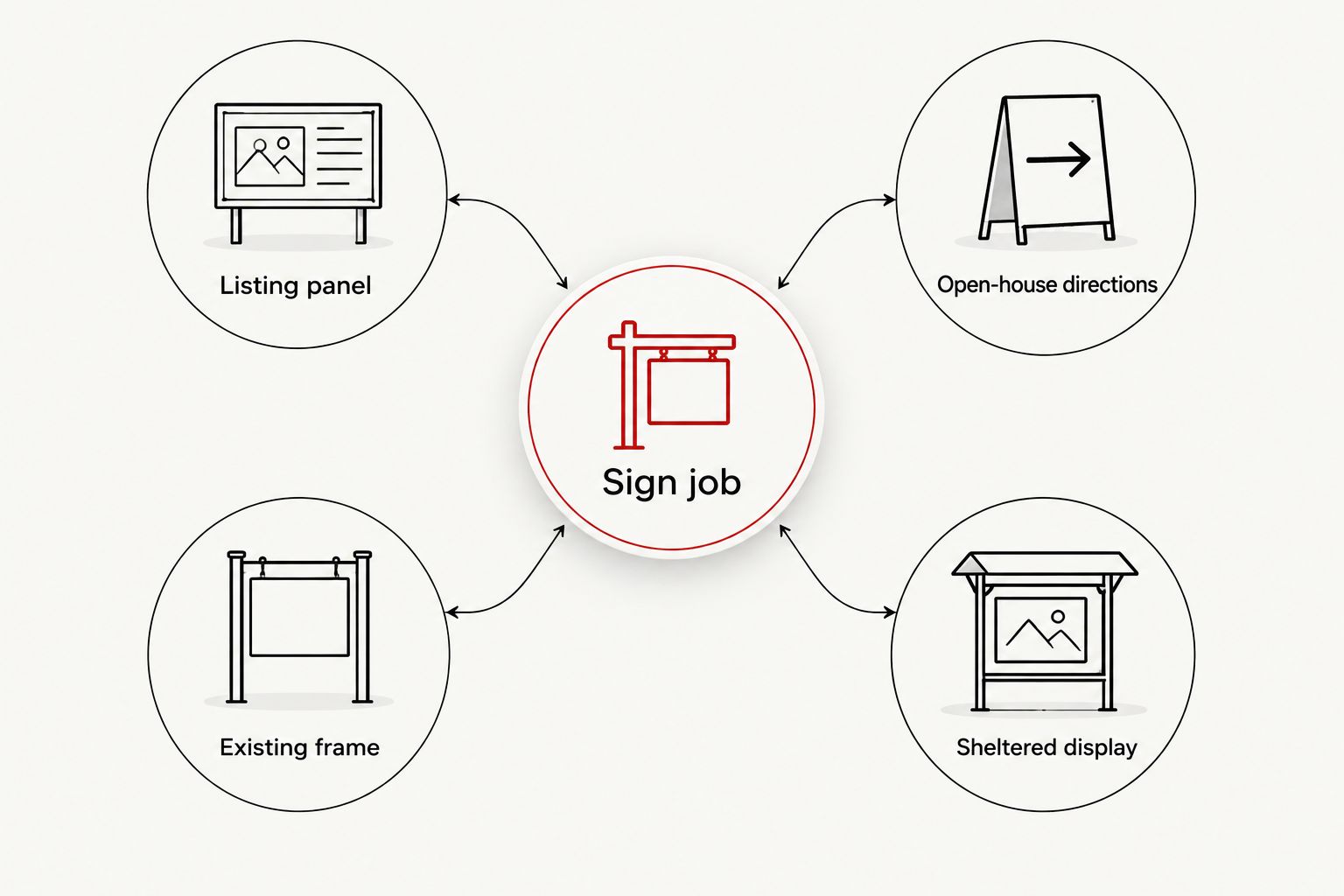
The simplest 2026 setup separates permanent branding from temporary directions. You do not need every panel to serve every purpose. Give each sign a clear assignment.
- Listing panel: Start with aluminum composite for a reusable rigid face, then confirm the mounting system.
- Open-house directions: Start with corrugated plastic and a compatible support.
- Existing frame: Check whether an aluminum replacement matches the frame's requirements.
- Sheltered display: Consider expanded PVC after confirming support and exposure.
A material shortlist is only the beginning. Ask how the finished panel will be supported, transported, and stored. Those details turn a suitable sheet into a workable business sign.
Make the message readable before adding more graphics
A durable panel with a crowded design still fails at its job. Put the essential message first, then remove anything that competes with it. A directional sign and a listing panel need different layouts.
For a directional sign, prioritize the event message and a clear arrow. For a listing panel, prioritize the brokerage or agent identity and the contact method, subject to applicable advertising requirements.
Use these checks before approving production:
- Check both approaches. If people approach from opposite directions, discuss 2 printed faces rather than assuming a single face covers the location.
- Choose a primary response. Give 1 primary phone number clear visual priority instead of making several contact methods compete.
- Review the surroundings. Check the layout against vegetation, parked vehicles, fences, and other visual clutter.
- Check required details. Confirm brokerage requirements and applicable real estate advertising rules before signing off.
A QR code can supplement contact information, but it should not be the only response method on a sign viewed from a moving vehicle. Keep the phone number readable and leave enough open space around the main message.
What to bring when requesting a quote
A useful quote starts with the complete job. For your 2026 order, bring the artwork, intended locations, frame details, quantity, and required completion date. Tell the shop which panels you expect to reuse.
Bring 3 reference photos: the intended placement, the mounting hardware, and the existing sign if you have one. Include measurements separately; photos alone do not establish dimensions.
Image Monster handles custom signs with in-house design and production. You can also discuss vehicle lettering or wraps if your real estate business needs identification beyond the property line. Treat that as a separate application with its own artwork and installation requirements.
How the materials are ranked
This ranking prioritizes reusable listing-panel rigidity, temporary-sign handling, mounting compatibility, exposure, and readability. Aluminum composite takes the default listing-panel slot; corrugated plastic takes the temporary-direction slot. Aluminum and expanded PVC serve more specific frame and display needs.
The ranking compares material characteristics, not tested products, quoted projects, or guaranteed service life. The final choice belongs to the finished specification.
Which yard sign material should you choose?
Choose aluminum composite for your main reusable listing panel and corrugated plastic for temporary open-house directions. Keep aluminum on the shortlist when replacing a compatible metal insert. Reserve expanded PVC for a supported display suited to its location.
Do not standardize every sign around one substrate simply to simplify ordering. Standardize the artwork, mounting details, and storage routine instead. That keeps your next replacement easier to specify.
FAQ
What's the best yard sign material for realtors?
Aluminum composite material is the default choice for a reusable rigid listing panel. Corrugated plastic is better suited to temporary open-house directions, where lightweight handling matters.
Is aluminum better than corrugated plastic for real estate signs?
Aluminum is better suited to a compatible framed metal panel; corrugated plastic suits temporary directional signs. Choose by mounting method and reuse needs rather than treating either material as best for every job.
Are aluminum and aluminum composite signs the same?
No. Aluminum signs use solid metal sheet, while aluminum composite panels combine aluminum faces with a composite core. Confirm the construction and mounting requirements before ordering.
Can real estate yard signs be printed on both sides?
Real estate yard signs can use double-sided graphics when the panel and mounting arrangement suit that construction. Discuss both viewing directions before approving the layout.
Is PVC a good material for outdoor listing signs?
Expanded PVC is not the default recommendation for an exposed listing sign. Its suitability depends on heat, support, panel size, and the finished construction; sheltered displays are a clearer fit.
What should I bring to a real estate sign consultation?
Bring artwork, panel measurements, frame details, placement photos, quantity, and your required completion date. Include an existing panel when you need a replacement to fit current hardware.
Where can Wilmington agents discuss custom real estate signs?
Wilmington agents can visit Image Monster at 4724 New Centre Dr or call (910) 313-1154. Bring the mounting details and artwork so the conversation covers the complete sign, not just the sheet material.
One last thing
Before replacing a panel, inspect the hardware that holds it. A new sign will not correct loose clips, an unsuitable stake, or a damaged frame. Bring the support details with you.
Related guides
- Sign materials for Wilmington storefronts
- Vehicle wrap materials for commercial fleets
- Vinyl banner materials for outdoor signage
Ready to plan your signs? Call Image Monster at (910) 313-1154 or visit 4724 New Centre Dr in Wilmington. Bring your artwork and frame details, and request a quote for the complete job.