Best overall: cut vinyl lettering. Best for full-color artwork: opaque printed vinyl. Best for changing promotions: removable vinyl. The best vinyl decals for storefront windows match your message, your glass, and what customers need to see before they walk inside.
- Cut vinyl lettering is the best vinyl decals for storefront windows choice for business names, hours, and services.
- Opaque printed vinyl suits full-color storefront displays; it blocks views through the covered glass.
- Perforated window film balances graphics and outward visibility, but lighting affects the result.
- Image Monster offers custom decals and in-house design and production for Wilmington businesses.
Why this matters
Your storefront window has two jobs: explain your business and let customers understand the space behind it. Covering every pane with artwork can work against that second job. Tiny lettering creates the opposite problem: plenty of open glass, but a message that disappears from the sidewalk.
For Wilmington businesses planning window graphics in 2026, start with the customer’s approach. Are people walking past the entrance, crossing a parking lot, or looking for your door from a neighboring business?
Image Monster creates custom decals with in-house design and production and brings over 25 years of experience to local projects. Bring photos of the storefront and a clear business goal, not just a request to fill the glass.
What makes the best storefront window decals?
Judge the material against these criteria before choosing a finish:
- Readability: Your business name and main service should remain understandable against the actual background behind the glass.
- Coverage: Decide which areas need graphics and which should preserve daylight, views, or a welcoming entrance.
- Message life: Permanent identification and frequently changing promotions need different removal expectations.
- Installation surface: Glass condition, existing films, coatings, and the intended application side affect material selection.
- Lighting: Reflections, interior lights, and the direction customers approach all change how a graphic reads.
- Design flexibility: Simple lettering, detailed photographs, privacy effects, and temporary offers call for different constructions.
Choose the message first, then choose the vinyl that supports it. A material selected for privacy is not automatically the right choice for a detailed promotional image.
Storefront window decals at a glance
These 2026 recommendations rank material types by business use, not manufacturers. Confirm the exact film, adhesive, print construction, and glass compatibility before approving production.
| Rank and option | Best for | Standout feature | Key limitation |
|---|---|---|---|
| 1. Cut vinyl lettering | Business names, hours, and service lists | Separate shapes without a printed background | Not suitable for photographs or continuous gradients |
| 2. Opaque printed vinyl | Full-color artwork and bold window panels | Printed graphics with solid coverage | Blocks views through the covered area |
| 3. Clear printed vinyl | Artwork with transparent surrounding areas | Leaves unprinted areas transparent | Color visibility depends on the background and ink construction |
| 4. Perforated window film | Graphics with some outward visibility | Perforations leave openings through the graphic | Lighting affects visibility and privacy |
| 5. Frosted-effect vinyl | Decorative screening and privacy zones | Diffused, etched-glass appearance | Does not provide detailed, full-color promotional artwork by itself |
| 6. Removable vinyl | Short-term promotional campaigns | Adhesive selected for planned removal | Removal conditions and surface compatibility still matter |
1. Cut vinyl lettering: best for everyday business information
Cut vinyl lettering uses individually cut letters and shapes rather than a printed rectangular panel. It suits a business name, opening hours, a phone number, and simple service descriptions. The uncovered glass remains open around the design.
For an everyday storefront display, this is the strongest default. Keep the information hierarchy simple: business identity first, primary service next, contact or entrance details where customers can find them.
Cut vinyl lettering pros:
- Leaves glass visible between letters and shapes.
- Works well for simple logos and text-based messages.
- Separates permanent business information from promotional panels.
Cut vinyl lettering cons:
- Cannot reproduce photographs or smooth color gradients as cut shapes.
- Fine details and small lettering complicate production and application.
- Contrast changes with the scene behind the glass.
Best for: Service businesses, offices, and shops that need clear identification without covering the window.
Verdict: Buy cut vinyl lettering for essential storefront information.
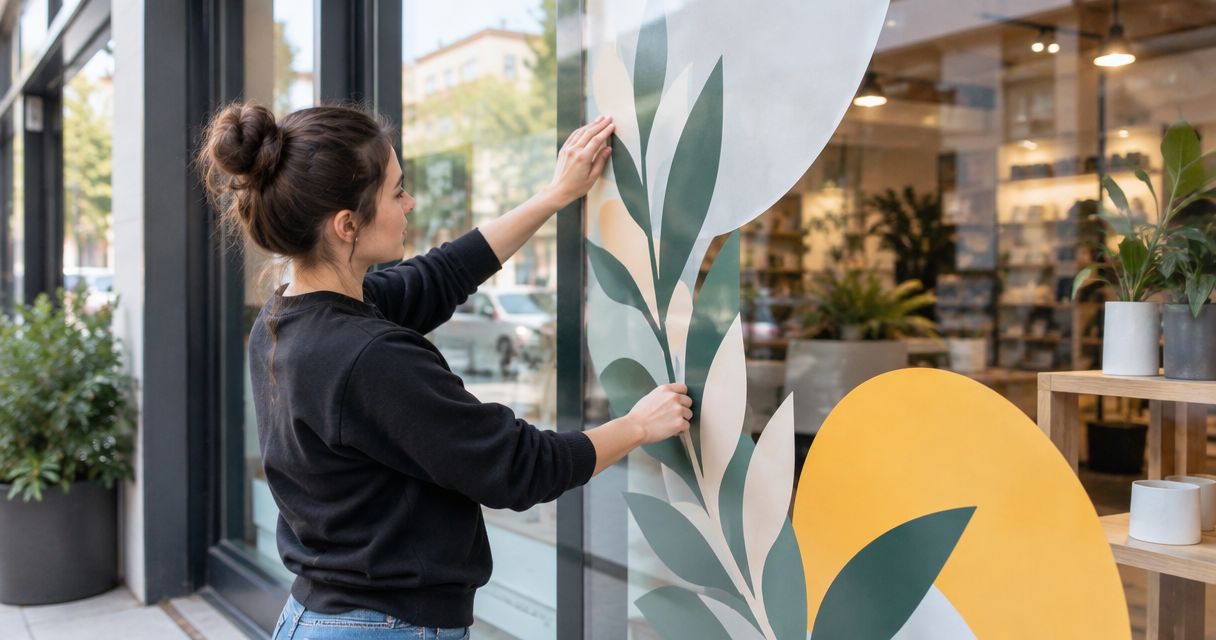
2. Opaque printed vinyl: best for full-color window artwork
Opaque printed vinyl supports photographs, illustrations, and multicolor designs on a background that blocks the view through the covered area. Use it when the artwork itself needs to be the focal point, rather than a frame around the interior.
Think in panels, not automatic full-window coverage. A defined graphic area can communicate a product category or service while leaving adjacent glass open. For a 2026 storefront refresh, decide what customers should still see inside before sizing the artwork.
Opaque printed vinyl pros:
- Supports photographs and complex brand artwork.
- Provides a solid background rather than relying on the interior scene.
- Can screen selected areas from view.
Opaque printed vinyl cons:
- Blocks visibility through the covered glass.
- Large graphic panels can hide merchandise or interior activity.
- Glass compatibility needs review, especially for extensive coverage.
Best for: Product imagery, illustrated service panels, and displays that deliberately conceal part of the interior.
Verdict: Buy opaque printed vinyl when artwork matters more than transparency.
3. Clear printed vinyl: best for artwork with open glass around it
Clear printed vinyl uses a transparent film as the print surface. Areas without ink remain transparent, allowing artwork to sit within a window without a solid white rectangle surrounding the design.
Transparency is also its main design challenge. Color can look different against a bright sky, dark interior, or objects behind the window. Ask whether the proposed print needs white ink or another backing construction to achieve the intended appearance; do not assume every clear decal includes it.
Clear printed vinyl pros:
- Preserves transparency in unprinted areas.
- Supports printed detail beyond simple cut shapes.
- Works for artwork intended to appear integrated with the glass.
Clear printed vinyl cons:
- Backgrounds and reflections affect color visibility.
- White elements require an appropriate print construction.
- A screen proof alone does not show real-world transparency.
Best for: Detailed logos and decorative artwork where visible glass is part of the design.
Verdict: Hold approval until the clear-vinyl construction and background are confirmed.
4. Perforated window film: best for graphics with outward visibility
Perforated window film contains small openings through the printed material. Those openings allow some visibility through the graphic while the printed surface carries the storefront message.
The effect depends on lighting and viewing conditions. Do not treat perforated film as guaranteed one-way privacy, especially when the interior is brighter than the exterior. Discuss the particular window, the lighting after dark, and how much detail the graphic needs to retain.
Perforated window film pros:
- Combines printed graphics with openings through the material.
- Preserves some outward visibility compared with opaque coverage.
- Suits large, simple messages better than crowded layouts.
Perforated window film cons:
- Does not provide dependable privacy under every lighting condition.
- Perforations interrupt fine text and small image details.
- Visibility differs from looking through uncovered glass.
Best for: Businesses that want a prominent graphic while retaining some outward view.
Verdict: Buy only after checking the visibility trade-off for your specific window.
5. Frosted-effect vinyl: best for decorative privacy zones
Frosted-effect vinyl gives glass a diffused, etched appearance. It suits meeting rooms, customer consultation areas, and portions of a storefront where direct views are distracting.
Use a band or selected coverage when only part of the space needs screening. Frosted film is a visual treatment, not a substitute for a specified safety or security glazing product. Silhouettes and shadows can remain visible depending on the film and lighting.
Frosted-effect vinyl pros:
- Diffuses direct views through the treated area.
- Supports decorative patterns and cut-out shapes.
- Separates screening needs from promotional messaging.
Frosted-effect vinyl cons:
- Reduces clear views through the covered glass.
- Does not guarantee complete visual concealment.
- Is not the default material for photographic advertising.
Best for: Offices and customer-facing spaces that need selective screening rather than a full advertising panel.
Verdict: Buy frosted-effect vinyl for defined privacy zones, not blanket privacy promises.
6. Removable vinyl: best for changing window promotions
Removable vinyl uses an adhesive designed for removal under specified conditions. It can carry printed artwork or cut lettering, so this recommendation concerns the adhesive and intended campaign life rather than a single visual style.
For a 2026 promotion, tell the sign shop when you expect to remove the graphic. The word removable does not mean residue-free on every surface after any length of time. Film specifications, exposure, glass condition, and removal technique still matter.
Removable vinyl pros:
- Supports planned changes to promotional messaging.
- Can keep campaign graphics separate from permanent identification.
- Offers a practical starting point for time-limited displays.
Removable vinyl cons:
- Has product-specific application and removal conditions.
- Does not guarantee effortless removal from every surface.
- Still requires a plan for removing the old campaign.
Best for: Scheduled promotions, temporary service announcements, and displays with a defined end date.
Verdict: Buy removable vinyl when the removal plan is part of the brief.
How these options rank
Cut lettering ranks first because it directly serves the basic storefront job: identifying your business while leaving glass open. The remaining options solve distinct needs—full-color coverage, transparent artwork, outward visibility, screening, or planned removal.
These are application-based recommendations, not durability test results. No single film wins every category. The right specification depends on the glass, artwork, lighting, and intended use.
Turn the choice into a useful quote request
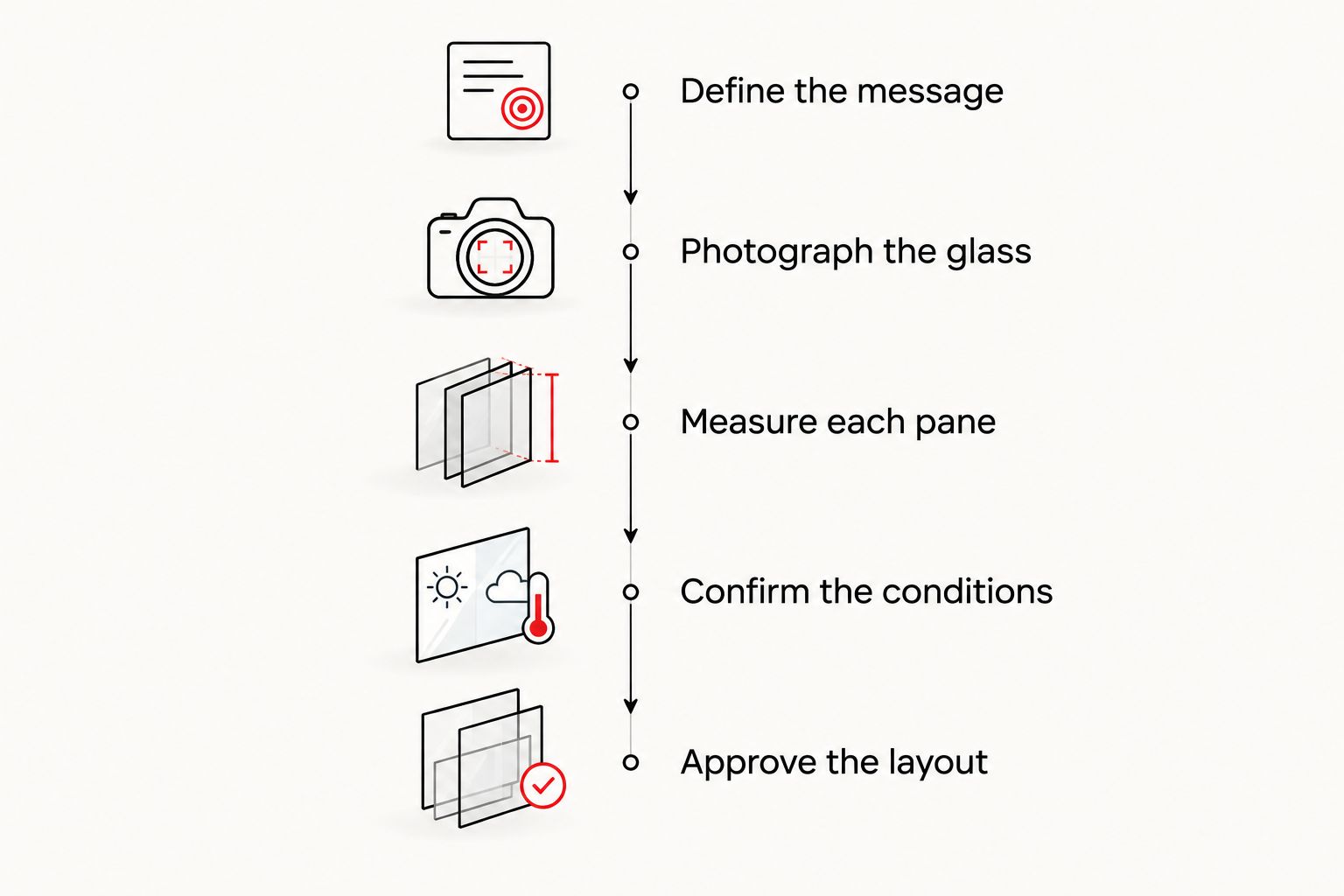
Give the sign shop enough information to recommend a construction, not just a decal shape. A practical 2026 project brief follows this sequence:
- Define the message: Write the main thing customers need to understand. Separate permanent identification from changing promotions.
- Photograph the glass: Include straight-on views and wider photos showing the entrance, surrounding signs, and interior background.
- Measure each pane: Record the glass dimensions and note handles, frames, existing graphics, and obstructions.
- Confirm the conditions: Identify existing window film or coatings and explain the desired application side and removal plan.
- Approve the layout: Check wording, coverage, contrast, and what remains visible through the window before production.
Test the layout from 2 viewing positions: the normal approach and directly outside the entrance. Give the display 1 primary action, such as entering the shop or calling your business. Those are design checks, not reasons to cram extra wording into unused space.
If your business also uses work vehicles, share the existing vehicle lettering with the designer. Matching the business name, service description, and contact details across your storefront and vehicles keeps the message consistent.
Which storefront window decals should you choose?
For Wilmington businesses needing clear storefront identification, Image Monster custom cut vinyl lettering is the best starting point. Add other materials only when they solve a separate problem.
Choose opaque print for image-led panels. Choose clear print when transparent surroundings matter. Choose perforated film for a measured visibility trade-off, frosted film for screening, and removable adhesive for a planned campaign change.
Before signing off in 2026, review the proposed graphic against the actual storefront photo. Check spelling, phone digits, door clearance, visible merchandise, and the view into the business. A clean layout beats a crowded pane.
FAQ
What's the best vinyl for storefront window lettering?
Cut vinyl lettering is the best starting point for business names, hours, and simple service information. It leaves the glass open between letters, but the color must contrast with the background behind the window.
Is clear vinyl better than opaque vinyl for shop windows?
Clear vinyl is better when transparent surrounding areas are part of the design; opaque vinyl is better when the artwork needs solid coverage. Clear printing requires attention to ink construction and background visibility.
Can people see through perforated storefront window graphics?
Perforated window film allows some visibility through openings in the material. Lighting and viewing conditions affect the result, so it should not be treated as guaranteed one-way privacy.
Should storefront window decals go inside or outside the glass?
The application side must match the specified film and print construction. Interior graphics viewed through glass can be affected by tint, reflections, and existing films, so confirm the installation method before production.
Will removable window vinyl leave adhesive behind?
Removable vinyl does not guarantee residue-free removal under every condition. The product's stated removal conditions, time on the glass, exposure, and surface condition all matter.
What should I bring when requesting storefront window decals?
Bring pane measurements, storefront photos, your logo artwork, and the exact wording you want displayed. Explain what must remain visible, whether existing window film is present, and when you expect to change the graphics.
Where can I discuss custom storefront window decals in Wilmington?
Discuss custom storefront window decals with Image Monster at 4724 New Centre Dr in Wilmington, NC, or call (910) 313-1154. Bring photos and measurements so the conversation starts with your actual storefront.
Related guides
- Sign materials for Wilmington storefronts
- Truck lettering styles for local businesses
- Vehicle wrap materials for commercial fleets
- Vinyl banner materials for outdoor signage
One last thing
Open glass is part of the design. Before adding another graphic, ask whether that space helps customers see your entrance, your products, or the people ready to serve them.
Call Image Monster at (910) 313-1154 or visit 4724 New Centre Dr in Wilmington to discuss your window decals and request a quote. Bring your storefront photos—and your vehicle lettering if the two need to work together.